A project manager’s position determines whose priorities they represent. A construction project management consultancy working for the client oversees the project on the client’s behalf, aligning scope, programme, cost, responsibilities and decisions. Contractor-side project management, by contrast, organises delivery of the agreed work. The roles must coordinate, but they are not interchangeable: one provides client-side oversight, while the other leads the contractor’s execution.
Both roles matter, and their responsibilities can blur when teams work closely together. This article explains what construction project management consultants do, how client-side and contractor-side responsibilities differ, and when independent oversight can help a client maintain clear governance and informed control. It also shows how a consultant supports decisions throughout the project, from defining responsibilities to monitoring delivery and raising issues that need attention.
Key Takeaways
- Use progress and risk reporting to identify emerging issues, clarify accountability and support timely decisions.
- Independent oversight gives clients objective advice focused on their interests, including when difficult issues need to be raised.
- Clear governance defines who makes decisions, who provides information and how issues move through the project.
- Match oversight and cost management support to the project’s needs so you can maintain visibility and control without adding unnecessary complexity.
What Do Construction Project Management Consultants Do?
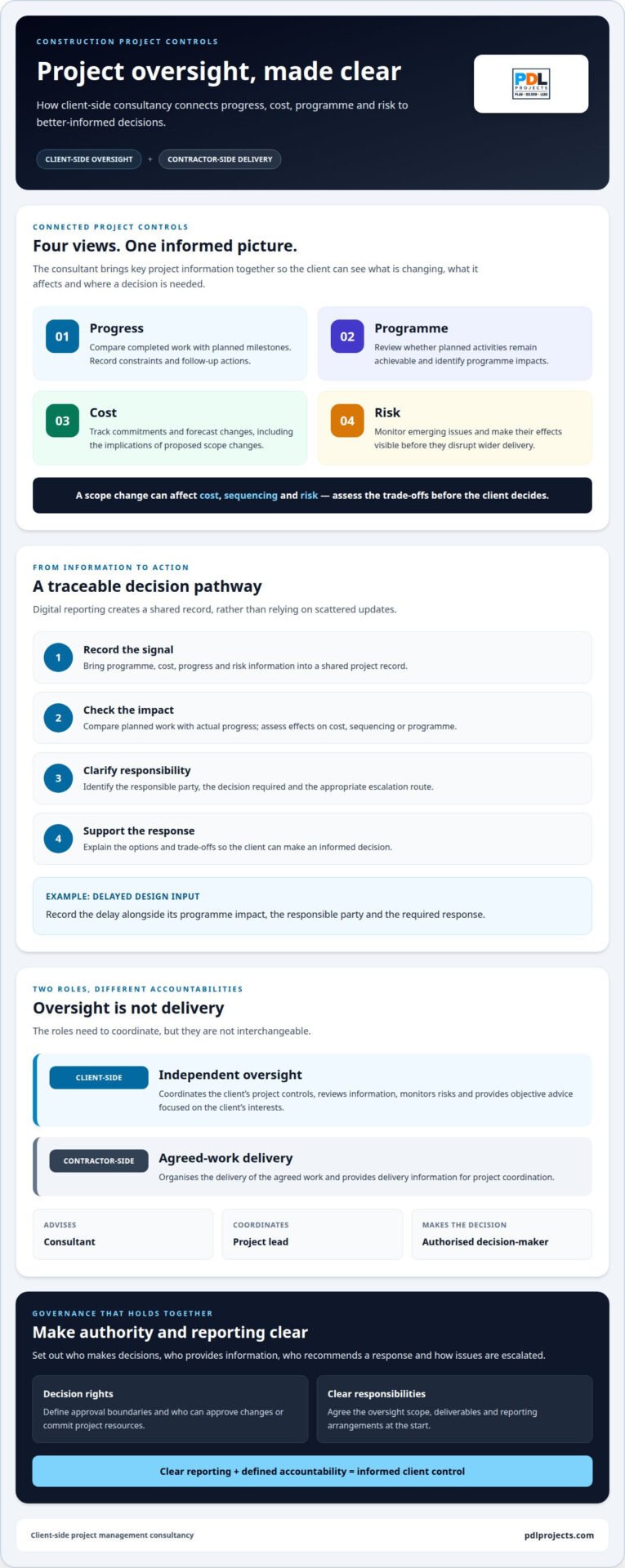
A consultant coordinates the client’s project controls, including progress reporting, cost reviews and risk monitoring. For example, they can bring programme updates and emerging issues into a single decision-making process.
Digital performance, progress and risk reporting
Digital reporting brings programme, cost, progress and risk information into a shared record. The consultant uses it to compare planned work with actual progress, identify emerging issues and clarify which decisions are needed. For example, a delayed design input can be recorded alongside its programme impact, the responsible party and the required response. This gives the client a traceable basis for prioritising action instead of relying on scattered updates.
Construction oversight and progress reviews
Construction oversight involves reviewing site progress, project records and reported issues against the agreed scope and programme. At a progress review, the consultant can compare completed work with planned milestones, record constraints and assign follow-up actions. This helps the client see where delivery is diverging and what needs a decision. Designers remain responsible for compliance with relevant regulations and standards; the consultant coordinates information and tracks issues within the project team.
Managing programme, cost and risk
Consultants manage programme, cost and risk by maintaining connected forecasts, monitoring changes and escalating decisions. A proposed scope change, for instance, can affect cost, sequencing and risk, so the consultant assesses those implications before the client decides. Cost reviews track commitments and forecast changes, while programme reviews test whether planned activities remain achievable. This joined-up view helps the client understand trade-offs and respond before an issue disrupts wider delivery.
How do you choose a construction project management consultancy in NZ? Compare its project experience, reporting approach, scope and decision-making responsibilities against your project’s needs.
What NZ building regulations and contract rules affect construction project managers? Contract documents define project roles and processes; designers are responsible for compliance with relevant regulations and standards.
How much do consultants charge in New Zealand? Fees depend on the project’s scope, complexity and reporting needs, and are provided after a quote request.
What qualifications and professional memberships should NZ project managers have? Consider relevant qualifications, memberships and practical experience alongside the project’s scale, complexity and responsibilities.
What are the risks of hiring a consultancy? Unclear scope, weak reporting or divided responsibilities can create gaps. Define authority, deliverables and reporting arrangements at the start of the engagement.
How do you engage a consultant in New Zealand? Set out the project objectives, required oversight, reporting expectations and decision rights in an agreed scope.
Why construction projects benefit from independent project management
Independent oversight gives the client a separate perspective on delivery, decisions and emerging concerns. Its value depends on clear responsibilities and advice focused on the client’s interests.
Independence and the client’s best interests
An independent consultant provides objective advice without taking on the contractor’s delivery obligations. The consultant should act in the client’s best interests and give honest advice, including when an issue is uncomfortable. For example, if a proposed change carries cost or programme consequences, the consultant can explain the trade-offs before the client decides. This separation supports informed choices instead of treating delivery updates as approval.
Independence also clarifies accountability. The client can distinguish the contractor’s view of progress from a separate assessment of the available information. If reported completion differs from observed progress, the consultant can document the discrepancy, explain its effect on decisions and identify what needs resolution. That record helps the client address the issue directly with the project team.
Independent construction advice and support
Independent construction support helps clients assess options, coordinate responsibilities and understand project information. It can be especially useful when a client lacks the internal capacity to interpret programme updates, commercial changes or competing recommendations. For example, a consultant can bring the relevant information together, explain the implications and identify the decision required, while leaving the client in control of that decision.
Advice is most useful when it addresses the decision at hand. A consultant can explain the assumptions behind a recommendation, set out the risks of each option and record the agreed next step. This gives the client a practical basis for resolving issues instead of relying on informal discussions that leave responsibility unclear. The consultant’s scope should define the advice and support required.
Clients seeking a defined oversight role can explore independent project oversight as part of their project planning.
Governance, reporting and decision-making
Governance defines who can approve changes, resolve issues and commit project resources. A decision register makes those responsibilities traceable and reduces ambiguity when priorities compete.
At project set-up, record each decision-maker, approval boundary and escalation route. For example, the client may retain approval of scope changes while a delegated project lead coordinates routine actions. The agreed structure should also identify who advises, who recommends a response and who makes the final decision. Clear boundaries prevent recommendations from being mistaken for approvals.
A useful governance framework connects project meetings, written reports and action records. Each update should identify the issue, its impact, the responsible person and the decision required. A design change, for instance, might affect sequencing and require client approval. Recording the issue and decision together helps the team understand the direction and follow through.
- Decision register: Record the decision, owner, rationale and resulting action.
- Issue log: Track open concerns, assigned responsibilities and resolution status.
- Approval pathway: Show which matters require client authority and which are delegated.
Reporting should distinguish facts, forecasts and decisions needed. If a contractor reports a milestone as complete, the project record should show the supporting evidence and any remaining dependencies. This makes the update useful to the client and gives the team a shared reference. Consistent formats also make changes between reporting periods easier to spot.
Escalation works best when the route is agreed before a dispute arises. If a cost change exceeds delegated authority, the project lead can document its basis, outline the implications and refer it to the authorised decision-maker. Meeting minutes should record the resolution, owner and next action. Together, these controls make accountability visible without transferring the client’s decision-making authority to the consultant.
Benefits for clients
A client gains a clearer view of commitments, constraints and choices. For example, an owner balancing an operational opening date against construction sequencing can use a coordinated project view to see competing priorities before they become last-minute decisions. It also helps the client’s internal team focus on approvals and business requirements instead of manually reconciling updates from separate project participants.
Independent support can strengthen the client’s commercial understanding. A cost plan, change record and forecast can show how a proposed scope adjustment affects the overall project position. For instance, the client can compare the consequences of changing a specification now with retaining the current scope. The consultant’s analysis informs the decision; the client remains responsible for setting priorities and approving changes.
- More informed decisions: Compare options against scope, timing and cost implications.
- Clearer coordination: Connect design information, site activity and client approvals.
- Better visibility: Track changes and outstanding actions in one project record.
Continuity is another practical benefit. When a project has several consultants and contractors, a consistent coordination point can help the client maintain context across meetings and decisions. For example, an unresolved design input can be tracked alongside the work it affects, the person responsible and the next action. That record reduces reliance on individual recollection.
Independent management is not necessary for every construction project. A client with a small, straightforward scope and sufficient internal capacity may manage coordination directly. The case for external oversight is stronger when multiple workstreams, complex interfaces or limited client resources make consistent control difficult. The right level of involvement depends on the decisions and coordination the project requires.
To clarify the oversight your project needs, explore project management consultancy as a way to align support with your scope, resources and delivery priorities.
PDL Projects: Project Management Consultancy
PDL Projects provides construction project management consultancy for organisations seeking structured support to deliver projects. This service can help when coordinating responsibilities, monitoring progress or maintaining clear project controls requires dedicated expertise.
When financial oversight is a priority, PDL Projects’ Cost Management & Quantity Surveying services support project cost needs. For professionals developing their capabilities, PDL Projects also offers specialised construction training.
Choose support that reflects your project’s requirements, whether you need consultancy, cost management or professional development. To discuss your project management needs, contact PDL Projects.
Set a clear direction for your next project
The value of a construction project management consultancy depends on how well its role fits your project’s requirements. Before work begins, define the outcomes you need, the decisions you’ll retain and the oversight that will help you make them. That clarity gives the appointed support a practical mandate and keeps responsibilities visible as the project develops.
PDL Projects offers Project Management Consultancy, Cost Management & Quantity Surveying, and CAPM® Foundation training. These services support project delivery, commercial oversight and professional development, depending on your needs. Discuss your project context with PDL Projects to identify the support that would be useful.
Contact PDL Projects to discuss your project and consider how structured support could fit your priorities. A well-defined starting point can help you move forward with greater purpose and a sound basis for decisions.
Frequently Asked Questions
Client-Side vs Contractor-Side Project Management: What’s the Difference?
Client-side project management represents the owner’s priorities; contractor-side management organises the contractor’s delivery. The client-side role coordinates the brief, approvals and project-wide interfaces, while the contractor’s manager plans site activities and manages the contractor’s resources. For example, a delayed equipment decision may need client approval, while the contractor adjusts its work sequence. The roles coordinate, but their authority and accountability differ.
What stages of a project do they get involved in?
Consultants can contribute from early project definition through construction and handover. During initiation, they help clarify the client’s objectives and scope; during design and procurement, they coordinate inputs and support informed decisions. During construction, their work may focus on oversight and delivery controls. At handover, they can track outstanding items and required project records, helping the client prepare for the transition into use.
What does a construction project management consultancy do in New Zealand?
A construction project management consultancy provides client-side coordination and controls to help deliver a project against its agreed objectives. Its work may include clarifying scope, aligning project participants, reviewing progress and preparing information for client decisions. For example, before a proposed change is approved, the consultant can bring together its effect on project requirements and delivery priorities. The client retains decisions assigned to its authority.
What services do NZ construction project management consultants offer?
Services can include project planning, programme coordination, progress reporting, risk management and cost oversight. Some consultancies also provide quantity surveying to support cost estimation and commercial monitoring. The precise scope depends on the client’s requirements: one project may need advice during planning, while another needs ongoing coordination during delivery. A written scope should identify outputs, responsibilities, reporting arrangements and decisions retained by the client.
What are the stages of construction project management in New Zealand?
Construction project management commonly moves through initiation, definition, planning, delivery, monitoring and closure. These stages organise the work but do not prescribe an identical process for every project. For instance, a client first establishes the need and scope, then develops plans and coordinates delivery. Monitoring continues alongside delivery, while closure addresses completion, outstanding items and the transfer of relevant project information.
How do construction project managers control budgets, timelines, and quality in NZ?
Managers use agreed baselines, change records and progress evidence to track cost, time and quality together. A proposed design change, for example, can be assessed for budget impact, schedule dependencies and specification implications before approval. Regular reviews compare actual progress with planned work, while quality records track inspections, issues and close-out actions. Clear responsibilities establish who reviews findings and who authorises corrective decisions.