
Projects are easier to steer when key decisions are made before work gathers pace. Effective project planning and delivery support starts with clear objectives, a defined scope and deliverables broken into manageable tasks. Then choose a delivery approach, allocate people based on their skills and availability, map risks and dependencies, and establish practical oversight from initiation.
A plan creates value when it guides decisions, not when it merely records intentions. Clear responsibilities, realistic schedules and agreed change processes help teams stay aligned as delivery progresses.
This guide explains how to set SMART objectives, document requirements and define the scope of work. It covers choosing a suitable delivery approach, planning resources and risks, and establishing the communication and review practices that support delivery. Together, these steps create a practical foundation for moving from a project’s purpose to coordinated execution and informed decisions.
Key Takeaways
- Set objectives that are specific, measurable, achievable, relevant and time-bound so the team can judge progress against a clear purpose.
- Document requirements and break the agreed scope into deliverables and tasks before committing to a delivery plan.
- Match resources to skills, availability and workload, and identify backup capacity to strengthen delivery resilience.
- Use initiation to establish responsibilities, risk ownership and change controls, then capture lessons at closure to inform future projects.
Why is the initiation phase crucial to project delivery?
For a New Zealand project, identify applicable legislation, consent conditions, contract terms and technical standards during initiation. Requirements depend on the project’s sector, site and planned work, so record each one and assign responsibility for monitoring it.
- Agree the project’s authority and decision path. Document the business need, intended outcomes, sponsor, decision-makers and approval limits before work begins. For example, a building project may need clear ownership of design decisions, procurement approvals and site coordination. Record assumptions alongside constraints, so the team can distinguish agreed requirements from matters still to resolve. This initiation record gives later decisions a reference point and helps prevent unapproved scope changes.
- Assess support providers against delivery needs. Define the work requiring support, then compare relevant project experience, governance capability, cost-control needs, reporting approach and role clarity. Ask how the provider will manage risks, escalate issues and transfer information to your team. Evaluate the proposed responsibilities against your internal capability, rather than selecting on credentials alone. A project management consultancy can help establish controls and coordinate delivery where internal capacity or oversight needs strengthening.
- Make risks actionable before mobilisation. List risks such as supply chain delays and resource shortages, then assess each by likelihood and impact. Assign an owner, record a response and set a review point. For example, identify an alternative sequence for work affected by delayed materials, and decide who tracks supplier updates. Revisit the register when assumptions change; a risk without an owner or response is only an observation, not a managed exposure.
- Close the project with evidence and lessons. At completion, confirm deliverables against acceptance criteria, record outstanding obligations and hold a retrospective with people involved in delivery. Capture what worked, what caused rework and which assumptions proved inaccurate. Turn each lesson into a practical change, such as updating a planning template or clarifying an approval hand-off. Store the decisions and actions where future teams can use them. Closure then improves planning tools and informs future project outcomes, rather than ending with a final status report.
Project execution and resource allocation
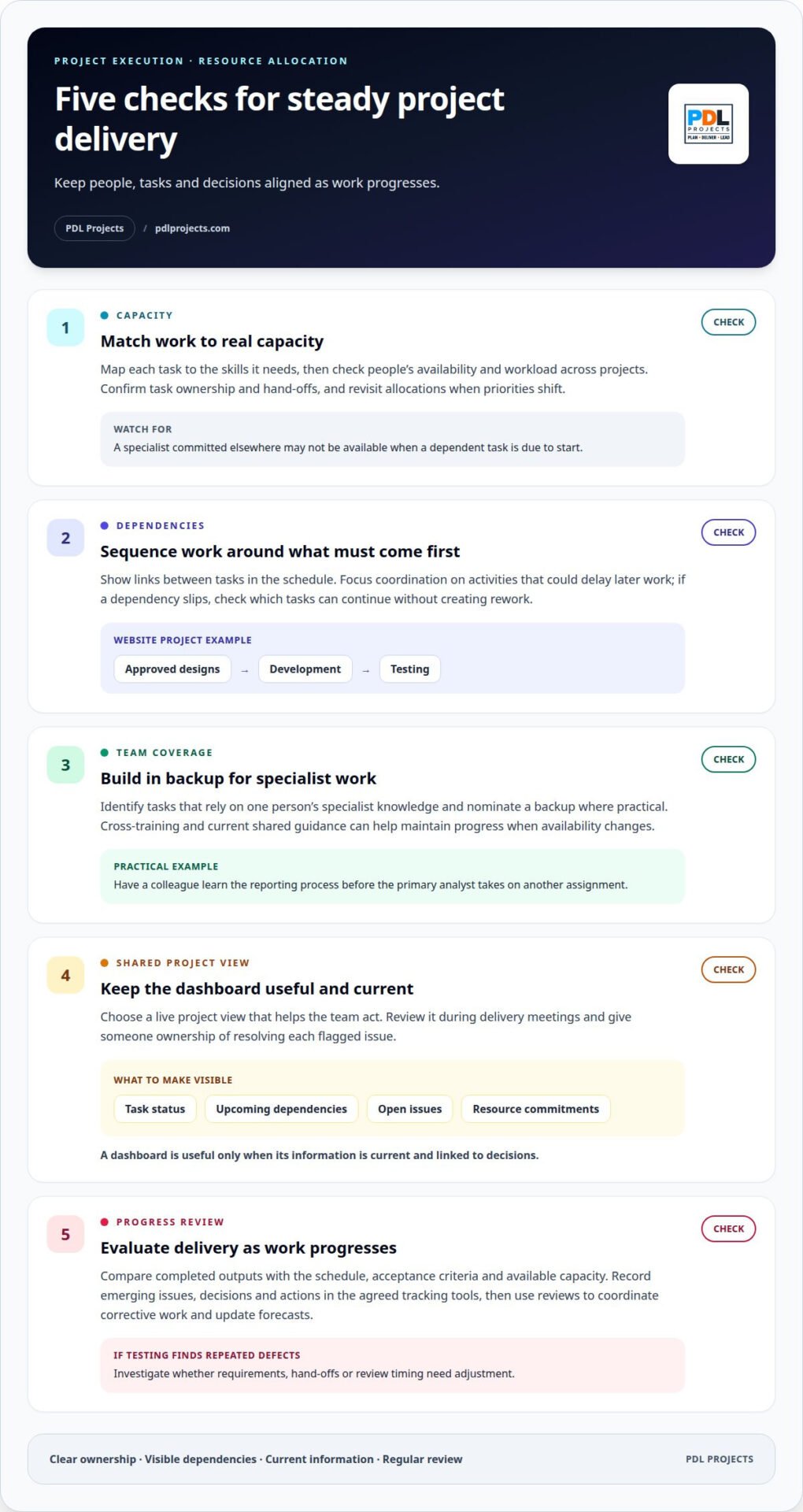
- Assign work against actual capacity. Map each task to the skills it requires, then compare assignments with people’s availability and workload across projects. For example, a specialist already committed to another delivery may not be available when a dependent task starts. Confirm ownership and hand-offs so responsibilities remain clear. Revisit allocations when priorities shift, rather than assuming the original schedule still reflects available capacity.
- Sequence work around dependencies. Identify tasks that cannot start until another deliverable is complete. For a website project, development may depend on approved designs, while testing follows completed development. Make these links visible in the schedule, then focus coordination on activities that could delay subsequent work. If a dependency slips, assess which tasks can proceed without creating rework.
- Build resilience into team coverage. Identify work that depends on one person’s specialist knowledge and nominate a backup where practical. Cross-training team members can help maintain progress when availability changes or unexpected challenges arise. For example, have a colleague learn the reporting process before the primary analyst takes on another assignment. Keep shared guidance current so a backup can act without relying on undocumented instructions.
- Use a live view to manage execution. A project management software dashboard can provide a real-time overview tailored to the project. Select measures that help the team act, such as task status, upcoming dependencies, open issues and resource commitments. Review the view during delivery meetings, and assign an owner to resolve each flagged issue. A dashboard is useful only when its information is current and linked to decisions.
- Evaluate delivery as work progresses. Compare completed outputs with the schedule, acceptance criteria and available capacity. Record emerging issues, decisions and actions in the project’s agreed tracking tools. For example, if testing identifies repeated defects, investigate whether requirements, hand-offs or review timing need adjustment. Use these reviews to coordinate corrective work, update forecasts and keep the team focused on delivery priorities. Project leadership support for clearer team communication can help managers maintain alignment as priorities and circumstances change.
Project objectives, scope and planning foundations
- Write objectives that define success. Use SMART criteria: Specific, Measurable, Achievable, Relevant and Time-bound. State the intended outcome, how the team will measure it, and when it should be achieved. For example, a website project might aim to launch a defined set of approved pages by an agreed milestone. Make the objective relevant to the organisation’s need, not merely a list of activities. A clear success measure gives sponsors and delivery teams a shared basis for decisions.
- Document requirements, inclusions and exclusions. Gather stakeholder needs and convert them into deliverables the team can review and accept. Record what falls outside the project scope as well; this helps distinguish new requests from agreed work. Then create a work breakdown structure, dividing each deliverable into manageable tasks. For a website, this could organise work into Design, Development and Testing, with specific outputs under each phase. Assign ownership so the team understands who will produce and review each item.
- Build a plan from the work, not assumptions. Estimate the sequence and dependencies of tasks, then represent them in a project schedule or Gantt chart. Link milestones to deliverables, and identify activities that rely on approvals, information or completed work. Include a risk management plan that records exposures, responses and owners. A project charter can bring the purpose, scope, governance and key assumptions together, giving decision-makers a concise reference when priorities compete.
- Test whether the foundations can guide decisions. Compare each proposed task with the objectives and agreed requirements. If a task has no clear link, clarify its purpose before committing resources. Check that milestones show progress towards measurable outcomes, rather than activity alone. Use the plan as a baseline for assessing requests: consider their effect on objectives, scope, dependencies and success measures before agreeing to changes. The practical takeaway is simple: make every planned deliverable traceable to a requirement and every requirement relevant to an objective.
What are the key stages of project planning and delivery in New Zealand?
- Initiate with a defined mandate. Record the project’s purpose, intended outcomes, sponsor and decision-making responsibilities. In New Zealand, identify relevant approvals, contractual commitments and technical requirements for the project’s sector and location. For example, a site-based project may depend on access arrangements or approvals before work can proceed. Note key assumptions and constraints, then assign someone to resolve each outstanding decision.
- Turn the mandate into a workable plan. Organise deliverables into tasks, map dependencies and estimate the sequence of work. Use critical path analysis to identify activities that directly affect the finish date. Add contingency time for unexpected delays, such as late information or materials, and show how changes to one task affect later milestones. Keep the schedule connected to available people and the requirements each deliverable must meet.
- Assess and manage delivery risks. Rate each risk by likelihood and impact, prioritise the exposures, then assign an owner to monitor each one. For example, a supply chain delay could affect a dependent task, while a resource shortage could slow several workstreams. Record a response, trigger for action and review point. Update the risk register as conditions change, so owners can act before an issue disrupts delivery.
- Use kickoff to align the team. Confirm project goals, responsibilities, communication expectations and the tools the team will use. Clarify who approves deliverables, reports progress and escalates issues. A kickoff should also explain how the team will record decisions and manage requests that could change agreed work. This shared operating approach helps participants coordinate across tasks, rather than working from different assumptions.
- Evaluate, adapt and close deliberately. During delivery, compare actual progress with milestones and assess whether corrective action is needed. Formalise proposed changes through a change-request process, assessing each against original goals and success criteria before approval. At closure, confirm deliverables and capture lessons for future planning. If you need structured oversight across these stages, strengthen your project delivery planning with expert support.
PDL Projects: Project Management Consultancy
PDL Projects provides Project Management Consultancy for organisations that need structured oversight to turn plans into coordinated delivery. Consider consultancy when responsibilities, dependencies or progress controls need clearer management, or internal capacity is stretched. It can help align objectives, scope, resources and governance with the work required. For projects where financial oversight is central, Cost Management & Quantity Surveying supports cost planning and control. PDL Projects also offers CAPM® Foundation and specialist construction training for people building project management capability. Choose support that addresses the project’s actual gap: consultancy for delivery oversight, cost management for commercial control, or training for professional development. Contact PDL Projects to discuss your project management needs.
Set your next project up for deliberate delivery
Turn planning decisions into a working agreement: clarify who owns each decision, how progress will be reviewed and how proposed changes will be assessed. This gives the team a shared basis for action before competing priorities reshape delivery. Keep the plan practical, with controls suited to the project’s complexity and the oversight your organisation needs.
Where additional capability would help, PDL Projects provides project planning and delivery support through consultancy, cost management and training. Choose the service that matches your current need, whether stronger coordination, commercial oversight or greater project management knowledge. A focused discussion can help you identify how that support fits your delivery approach.
Contact PDL Projects to discuss your project and take the next step towards a clear, well-governed delivery plan.
Frequently Asked Questions
What is Project Planning?
Project planning turns an intended outcome into an agreed route for achieving it. It defines what must be delivered, the sequence of work, required inputs and how progress will be measured. For example, a system replacement plan might make data migration a decision gate, so testing starts only when records are ready. This gives the team a shared basis for coordinating commitments and managing dependencies.
What is project management?
Project management directs and controls work from approval through completion. It coordinates people, priorities, information and decisions to keep agreed outcomes central. If a supplier’s delivery date changes, for example, the project manager assesses which tasks are affected, brings the relevant decision-makers together and adjusts the delivery approach. This connects day-to-day activity with governance, helping the team respond coherently as circumstances change.
What does project planning and delivery support include?
Project planning and delivery support can include schedule development, governance controls, dependency coordination, risk and progress monitoring, decision management, and resource or cost oversight. The right mix depends on project needs and internal capability. A team without commercial visibility may need cost tracking, while a cross-functional initiative may need clearer reporting and escalation. Effective support addresses a specific delivery gap and helps the team act.
What qualifications should project planning and delivery consultants have in New Zealand?
Assess a consultant’s relevant project experience, governance capability, cost-control approach, reporting methods and role clarity. Ask how they manage risks, escalate issues and transfer information to your team.